Describe the Current Role of Aquaculture in Providing Seafood
Kentucky State University Division of Aquaculture Frankfort Kentucky USA. With 90 of the worlds fisheries either harvested up to or beyond their biological limits fish farmingaquaculturewill increasingly be the means to meet the growing populations demand for seafood.
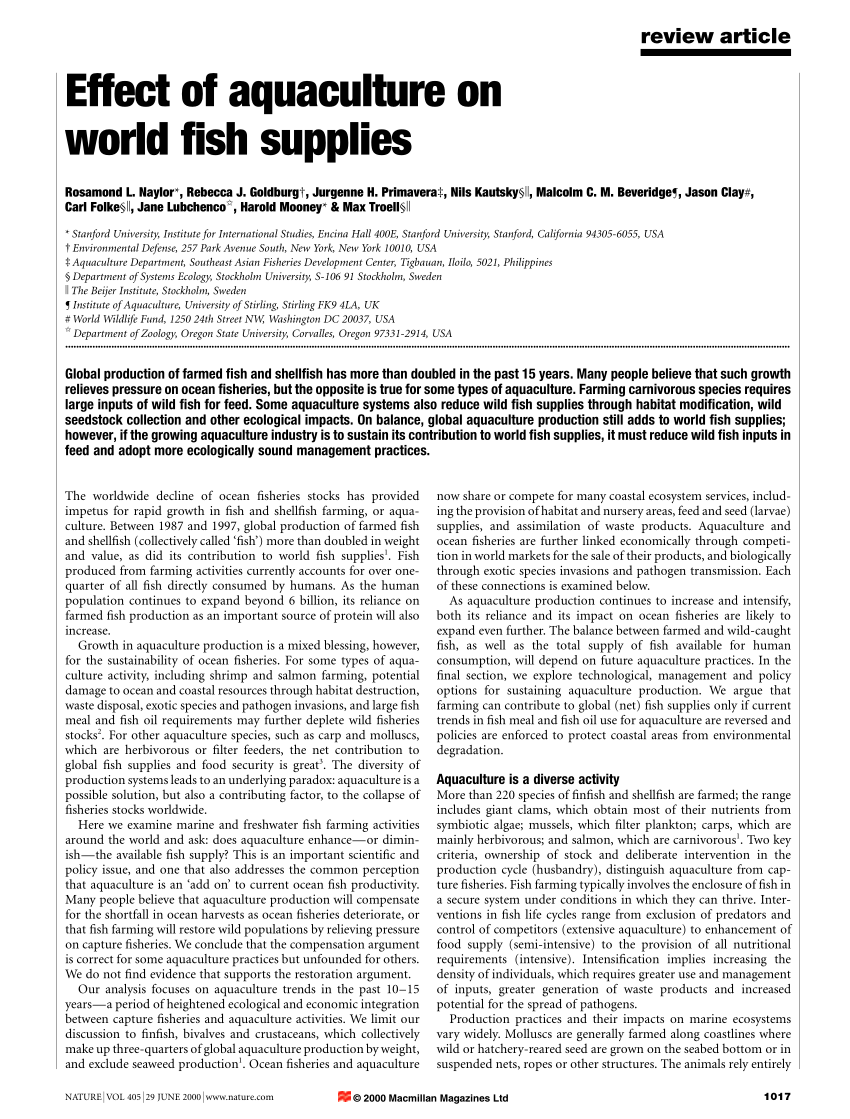
Pdf Effect Of Aquaculture On World Fish Supplies
Aquaculture is a method used to produce food and other commercial products restore habitat and replenish wild stocks and rebuild populations of threatened and endangered species.

. Yet another influence are rapidly increasing land prices and competition. Aquaculture has expanded fish availability to regions and countries with otherwise limited or no access to the cultured species often at cheaper prices leading to improved nutrition and food security. Search for more papers by this author.
The decimation of ocean fisheries through decades of over-fishing and the desire to sell more seafood cheaply has led to the rapid privatization of ocean waters on an industrial scale. As operations expand so does the amount of farmed seafood and fish consumed. Describe the current role of aquaculture in providing seafood.
Coastal ecosystems are threatened by coastal pollution loss of habitat overfishing and face an added threat amplifiers of climate change. The latest research affirms that aquaculture can help restore ocean health as well as support economic development and food production in coastal communities worldwide provided that the right practices are deployed in the right places. At the global level since 2016 aquaculture has been the main source of fish available for human consumption.
Seafood supply and US. As the demand for seafood has increased technology has made it possible to grow food in coastal marine waters and the open ocean. Aquaculture the farming of fish and seafood is one of the fastest growing sectors of the global food production industry.
To establish whether a multitrophic integrated aquaculture system is economically viable Bellona has initiated a project called Ocean Forest in partnership with the Leroy Seafood Group. The rearing of aquatic organisms under controlled or semi-controlled conditions - Refers to organisms that spend their whole life cycle in water most of the time - Includes organisms raised for. Aquaculture both freshwater and marine supplies about 5 percent of the US.
The authors further state that with aquaculture expansion ever increasing amounts of small pelagic fish would be caught for use in aquaculture feeds to expand the total supply of commercially valuable fish. Sustainable aquaculture growth is key to easing pressure on wild fish stocks which are globally under stress as a result of overfishing. The Future of Responsible Aquaculture.
When done in the right way and in the right places commercial aquaculture can accelerate ecosystem recovery in addition to providing sustainable seafood and green jobs in coastal communities. It has absorbed almost all of the growth in global demand in recent decades and will continue to play a critical role in protecting wild fish populations as demand for seafood continues to rise. However a clear pathway for implementation is vital to success.
With demand rising and many marine fish stocks already overfished nearly half of all seafood now comes from aquaculture which has grown at a. Aquaculture has the potential to improve the health of our planet and the health of our population as long as it is done in a manner that is environmentally friendly socially responsible and considers food safety and. However the recent growth in aquaculture has helped increase the supply of seafood kept the overall price of fish down and eased the pressure on wild-caught fish stocks.
The industry is challenged with the responsibility of feeding a rapidly growing global. Land dedicated to fish ponds will produce ten times or more consumable product than the same land used to raise cattle or pork while requiring significantly less input. Direct consumption Delayed consumption - Can include the use of wild-caught organisms.
As we see aquaculture production has now surpassed wild catch. The primary aim of Ocean Forest is to establish new forms of farmed biomass for use as food feed energy and raw materials for industry and agriculture through cooperation with. Reduce the need to import seafood.
Aquaculture production contributes to the overall global seafood supply. Marine aquaculture supplies less than 15 percent. Farms operating in US.
Department of Primary Industries NSW Department of Trade and Investment Regional Infrastructure and Services Port Stephens Fisheries Institute New South Wales Australia. Aquaculture is currently the worlds fastest growing food industry and now accounts for over 50 of the total global seafood supply. The Role of Aquaculture.
Aquaculture is one of the fastest growing primary industry sectors and has demonstrated the ability to. Most importantly when it is carried out responsibly aquaculture is an environmentally friendly source of healthy and nutritious protein that will play a critical role in feeding the worlds growing population. Reduce pressure on wild fisheries.
The primary responsibility of aquaculture is to efficiently complement wild-caught fish options to increase the amount of seafood available worldwide. As of 2017 half of all fish and seafood comes from aquaculture operations. It is vital that the United States further develop its own sustainable aquaculture industry both to reduce its annual 9 billion annual seafood import deficit and to keep pace with the growing demand for.
Fish farming is typically much more efficient than cattle or pork production and other forms of agriculture. Meet variations in annual market demand cycles. 2000 reported that aquaculture is a contributing factor to the collapse of fisheries stocks world-wide.
Waters are subject to some of the most comprehensive environmental seafood safety and regulatory programs in the world. Also has the most area suitable for aquaculture production in the marine environment in terms of desirable water depth current speed and access to coastal infrastructure. From employing off-season fishermen to installing new ice houses and processors expanding domestic aquaculture can play a critical role in providing economic stability to our fishing communities.
Globally aquaculture supplies more than 50 percent of all seafood produced for human consumptionand that percentage. Produce great tasting consistently high-quality seafood. In addition to reducing the seafood trade deficit these farms could generate tens of thousands of new jobs on Americas working waterfronts.
Be clean green and safe. Aquaculture is no different and in fact plays a critical role in this arena. Beyond these reasons there is also more advanced technology that allows aquaculture operations to expand and intensify.
In fact US. In fact aquaculture already yields more seafood than the worlds fisheries.
Pdf Sustainable Aquaculture Through The One Health Lens
Schematic Of An Integrated Multi Trophic Aquaculture Imta Example Of Rainbow Trout In A Polar Circle Cage Mussels On Aquaculture Fish Farming Urban Farming
Pdf Aquaculture A Rapidly Growing And Significant Source Of Sustainable Food Status Transitions And Potential


Comments
Post a Comment